Flat town, one real hill, one gear. How to check before you buy
A single-speed cruiser, a seven-speed Dutch-style roadster or a secondhand mountain bike with the bars flipped up, ridden on the same errands
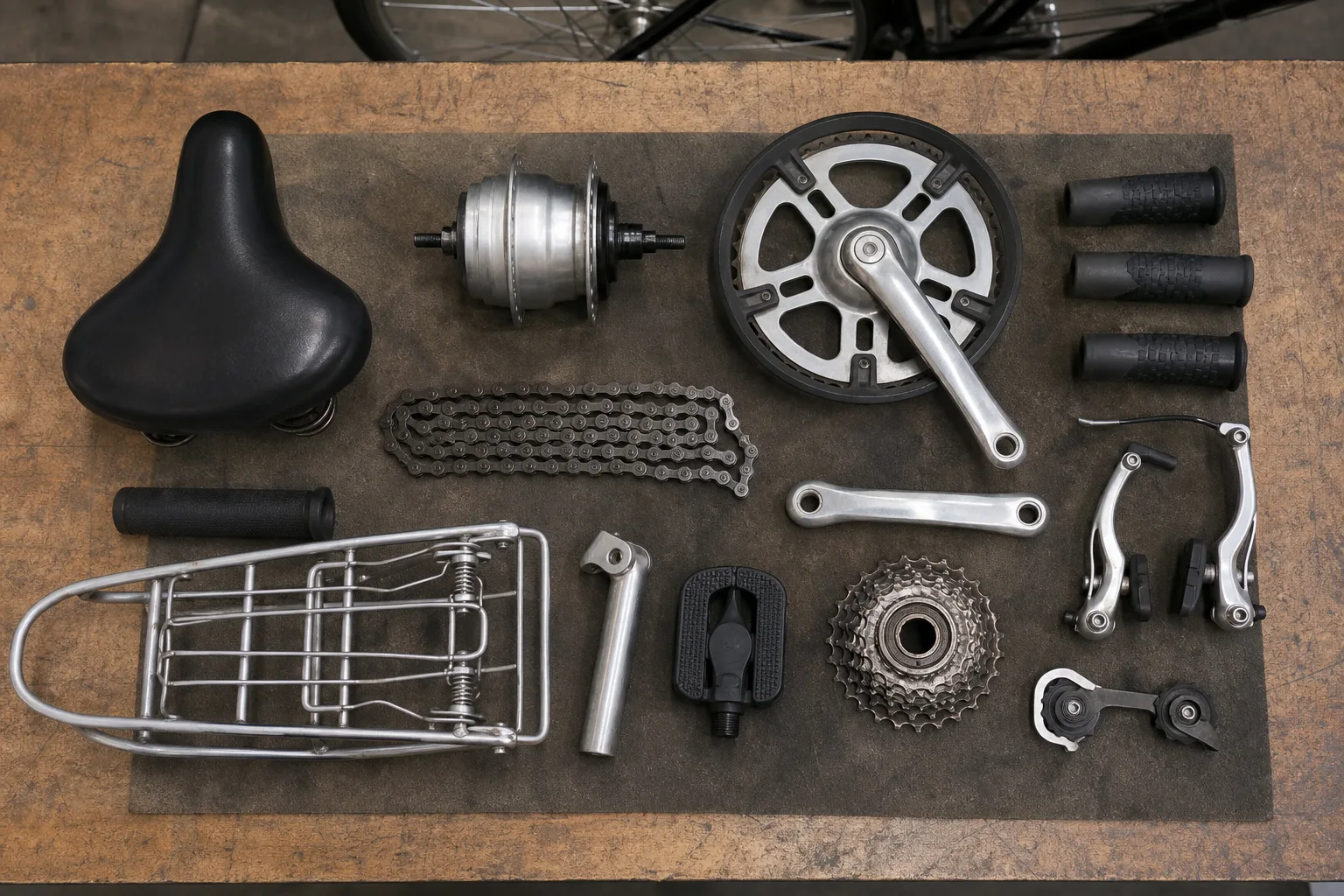
Every shop has a phrase for gearing on an upright bike, and none of the phrases mean anything you can act on. Geared for the city. Perfect for flat riding. Plenty for errands. What you want instead is a number you can compute yourself in about thirty seconds, compare across three bikes on three different websites, and check against the one street on your route that actually rises. That number is gear inches, and it is the single most useful thing a careful reader can extract from a spec sheet that is otherwise mostly adjectives.
Gear inches, and why the number beats the description
Gear inches is the diameter of the wheel multiplied by the chainring's tooth count divided by the cog's tooth count. A common relaxed setup, a 46-tooth chainring driving an 18-tooth cog on a 28-inch wheel, comes out near 71. On a hub-geared bike you multiply that same result by the hub's internal ratio for each gear. The arithmetic is not the point; the comparability is. Once you have gear inches, a Dutch roadster, a step-through cruiser and a seven-speed commuter all sit on the same scale, and the shop's vocabulary stops mattering.
Roughly speaking, anything in the low fifties and below feels like a climbing gear on a heavy upright bike, the sixties are comfortable rolling, the low seventies are a fast flat cruise, and the eighties and above are for downhill or a tailwind. Those bands shift with your legs and your load, so treat them as a starting frame rather than a verdict. The useful discipline is writing down the number for every bike you are considering, including the borrowed one you already like, so you are comparing gearing instead of impressions.
What a grade and a full basket actually cost you
A single speed near 70 gear inches is genuinely pleasant on flat ground with an empty rack, which is why so many town bikes ship that way and why so many owners are happy for a year. The trouble arrives in combination. A grade of two or three percent is barely visible and merely slows you down. Around five percent, on a thirty-five pound bike, in ordinary clothes, most riders start standing on the pedals. Add twenty-five pounds of groceries and a headwind, and the same hill becomes a walk. Gradient alone rarely defeats one gear. Gradient plus load does.
Check your actual route rather than the town's reputation. Flat towns are flat on average, and averages hide the railroad overpass, the bridge approach, the ramp out of the river bottom and the one block near the hospital. Ride the loaded version of your errand once on whatever bike you have, note where you slow, then ask whether you are willing to walk that stretch weekly for the next several years. If the honest answer is no, you are shopping for hub gears, not for a lighter single speed.
Coaster brakes, three-speed hubs, and shifting while stopped
Coaster brakes stop the bike by back-pedaling, which is simple, weatherproof and invisible to theft, and they pair naturally with single speeds and with three-speed hubs that include a coaster version. The Consumer Product Safety Commission is the federal body responsible for bicycle braking requirements, and a coaster brake bike sold in the United States is built to that framework. What a careful reader checks is different: whether the bike also has a front brake, because a coaster alone on a loaded bike descending anything meaningful is thin, and because a back-pedal brake gives you no way to hold the bike still on a slope while your feet are down.
The classic three-speed hub gives you roughly a third lower and a third higher than direct drive, which is enough to turn a five percent grade from a stand-up grind into a seated slog. Its real advantage is that it shifts when you are not pedaling, so you can drop into low while stopped at the light at the bottom of the hill. Seven-speed hubs widen that spread considerably and add closer spacing in between, at more money, more weight and slightly more drag.
Derailleurs, and what to inspect before you pay
A derailleur drivetrain gives you the widest range for the least money and the least weight, and on a bike ridden in dry weather and stored inside it works fine for years. It also hangs low, needs the chain moving to shift, and dislikes salt and neglect. Before you buy anything, compute gear inches in the lowest gear, sit on the bike and shift through the whole range in the parking lot, spin the cranks backward to hear the chain, and confirm there is a front brake independent of the pedals. Those four checks tell you more than any description will.